 Language
Blog
News Center
Tilt sensor market development analysis: APAC holds a larger market share
Category:
Industry News
Publish Time:
2020-07-08
With the advent of the Internet of Things, the applications of inclination sensors are constantly expanding. In recent years, earthquakes, tsunamis, and food crises have been on the rise, posing a challenge to researchers to develop various sensors to detect the occurrence of these phenomena and provide early warnings.
Inclination sensors, also known as inclinometers, tiltmeters, level gauges, or tiltmeters, are frequently used to measure changes in the horizontal angle of a system. The evolution of level gauges from simple bubble levels to today's electronic levels is a result of advancements in automation and electronic measurement technologies.
An inclination sensor is actually an accelerometer that utilizes the principle of inertia. When the inclination sensor is stationary, it is only subject to gravity; therefore, the angle between the vertical axis of gravity and the sensitive axis of the sensor is the required inclination angle.
When the monitored object deviates in angle, the inclination sensor can promptly detect the angle data and issue an alert to prevent disasters. As a detection tool, inclination sensors have become indispensable measurement tools in fields such as geological monitoring, bridge construction, railway laying, civil engineering, oil drilling, aviation and navigation, industrial automation, intelligent platforms, machinery processing, and medical machinery.
For example, inclination sensors are widely used in modern security systems. As a safety component, inclination sensors can automatically detect and issue alerts in case of anomalies to prevent further escalation of danger. In modern security systems, inclination sensors are often used in drones and smart manhole covers.
Analysis of the Current Status of the Inclination Sensor Market
According to Yole Développement, the increasing demand for inclination sensors in the mining and construction, aerospace and defense, and automotive and transportation industries is driving market growth. The inclination sensor market is expected to grow from $150.8 million in 2016 to $260.3 million in 2023, with a compound annual growth rate (CAGR) of 8.17% during the forecast period.
A specific analysis of the inclination sensor market from four aspects: housing material, technology, industry, and region.
In terms of housing material, the inclination sensor market is currently dominated by non-metallic housing materials.
In terms of technology, MEMS-based inclination sensors are expected to experience significant market growth due to their small size and low cost.
In terms of industry, the mining and construction industry accounts for a significant market share of the overall inclination sensor market. Inclination sensors are used in numerous mining and construction equipment and machinery, such as drilling machines, mobile and stationary cranes, and structural monitoring systems. Therefore, the mining and construction industry plays a dominant role in this market.
In terms of region, the Asia-Pacific region (APAC) holds a significant market share of the inclination sensor market. China, Japan, and India are the main countries driving the growth of the inclination sensor market in the Asia-Pacific region. The Asia-Pacific region has numerous well-known mining and construction, aerospace and defense, and automotive and transportation companies. In addition, some key operators in the inclination sensor market are located in the Asia-Pacific region, which has also had a positive impact on the market in the Asia-Pacific region.
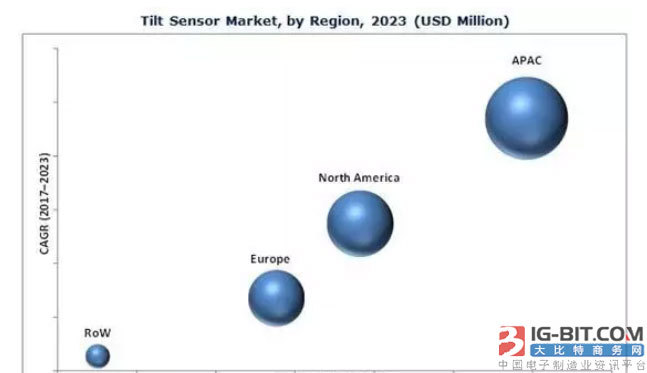
2023 Inclination Sensor Market Forecast by Region (Source: Yole Développement)
Seven Major Market Trends for Inclination Sensors
In the future development process, as the application fields of inclination sensors become increasingly wider, products will increasingly develop towards miniaturization, automation, and intelligence. At the same time, with the popularization of the Internet of Things and information technology, information technology has become a future development trend for tilt sensors.
Utilizing newly discovered phenomena and effects
Inclination sensors are inherently based on a series of effects. Many effects are currently used, such as the piezoelectric effect and piezoresistive effect, and there are some effects that are unknown to us, waiting for us to understand.
Adopting advanced technologies
With the development of computer, electronic, and manufacturing technologies, inclination sensors have also entered a period of rapid development. These technologies are the basis for the development and design of inclination sensors. High-tech inclination sensors are a direction for future industrialization.
Development of new materials
The sensing elements and the basis for protecting inclination sensors are various materials. With people's mastery of the properties of new materials, it will greatly promote the development of inclination sensors. In recent years, widely used materials include ceramics, optical fibers, and high-molecular organic materials.
Continuously improving sensor performance
Many factors affect the performance of inclination sensors, both systematic and detection-related. With the development of detection technology and precision manufacturing, this aspect will also be greatly improved.
Expansion of sensor applications
With the advent of the Internet of Things, the applications of inclination sensors are constantly expanding. In recent years, earthquakes, tsunamis, and food crises have been on the rise, posing a challenge to researchers to develop various sensors to detect the occurrence of these phenomena and provide early warnings.
Integration and multi-functionality of sensors
Previous inclination sensors generally could only detect one physical quantity, and a system of optical sensors required a lot of space. Now, multi-functional and integrated sensors have emerged, such as integrated sensors for temperature, humidity, and various gases. This will also be a future development trend.
Miniaturization and low power consumption
Some precision instruments or equipment are small in size and require various inclination sensors for sensing and control, which also puts higher demands on inclination sensors.
Disclaimer: The reprinting of this article is for the purpose of disseminating more information. If there are any errors in the source annotation or infringement of your legitimate rights and interests, please contact us, and we will correct and delete it in a timely manner. Thank you. The above content and views are unrelated to this company and website!
Keywords:
Previous:

日月仪器
Contact Fax:0552-4070672
Company Website:www.sunmoon-china.com
Email:smsales@163.com
Address: No. 985, Xingzhong Road, High-tech Zone, Bengbu City, Anhui Province, China, Sun Moon Science and Technology Park
Made in China